Ultimate Guide to Multi-Tier Supplier Workflow Automation
%202%20(1).png?width=50&height=50&name=20250501_1415_Professional%20LinkedIn%20Update_remix_01jt6gxkjmekavnvzsewk61z9w%20(1)%202%20(1).png)
TL;DR: Multi-tier supplier workflow automation simplifies supply chain management by replacing manual processes with AI-driven tools. It provides real-time visibility, reduces repetitive tasks, and helps manage risks across all supplier levels. This guide explains how to implement automation, improve efficiency, and strengthen supplier relationships.
Managing suppliers across multiple tiers is often chaotic, with limited visibility, manual follow-ups, and delayed updates. Automation changes this by centralizing data, integrating with ERP systems, and using AI to predict and prevent disruptions. Key benefits include saving time (up to 50% for buyers), reducing errors, and responding faster to supply chain risks. Tools like AI-powered platforms, purchase order tracking automation, and supplier scorecards make this transformation possible.
Learn how to:
- Map your supply chain to uncover risks.
- Standardize supplier data collection for consistency.
- Integrate automation tools with your ERP for real-time updates.
Automation isn't just about saving time - it's about running a smarter, more efficient operation.
Multi-Tier Supplier Automation Benefits and ROI Statistics
Common Problems in Multi-Tier Supplier Management
Poor Visibility Across Supplier Tiers
Managing multi-tier suppliers often comes with a major challenge: limited visibility beyond Tier-1 suppliers. Most manufacturers have a clear view of their Tier-1 suppliers - the ones they directly purchase from. But things get murkier as you move deeper into the supply chain. If a Tier-2 or Tier-3 supplier faces a raw material shortage or production delay, you might not find out until your Tier-1 supplier misses their delivery. This lack of transparency leaves you blindsided by risks that only become apparent once they’ve already disrupted your production.
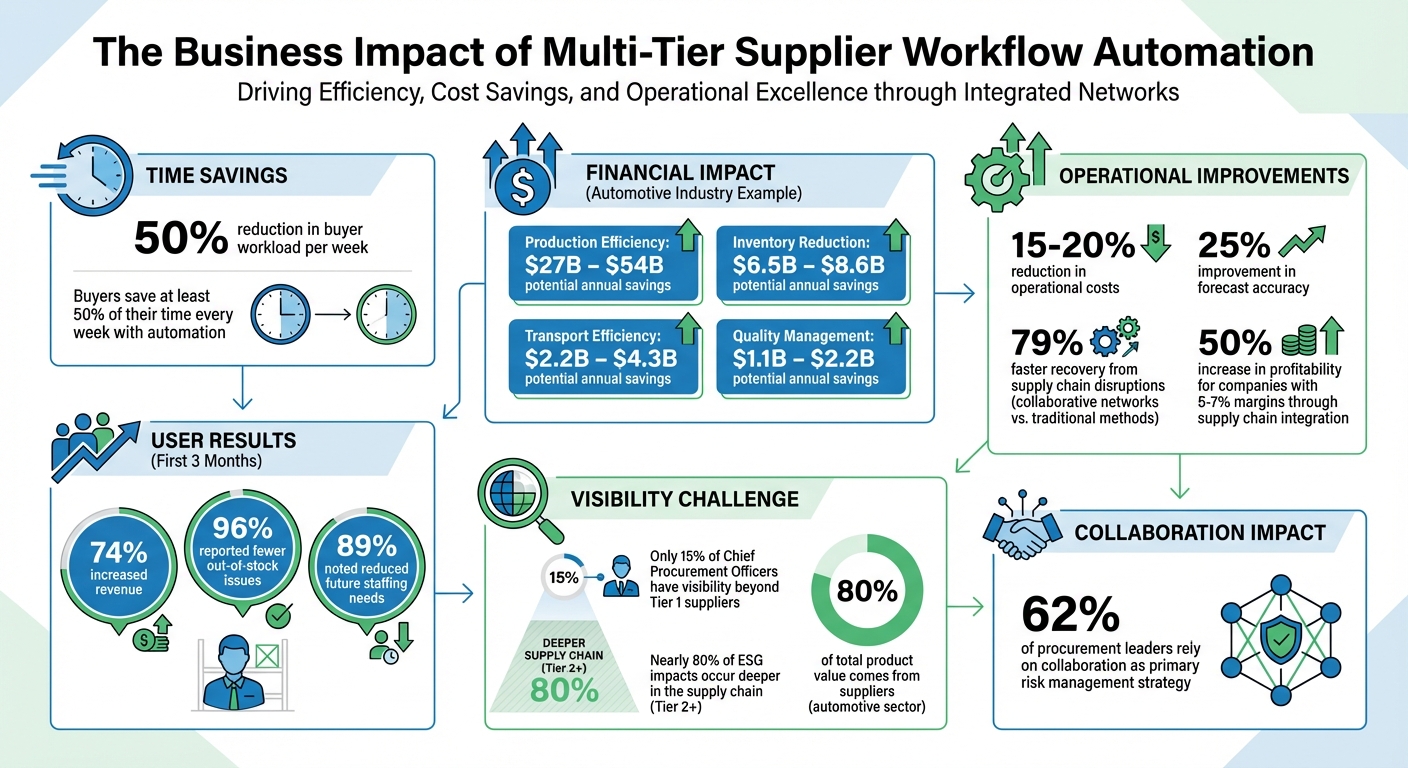
Take the automotive sector, for example, where suppliers contribute to 80% of the total product value. A single hidden issue at a Tier-3 supplier can bring your entire production line to a standstill. These gaps in visibility don’t just create risks - they also lead to inefficiencies that ripple through your operations.
Manual Work and Communication Problems
Traditional supplier management often depends on outdated, fragmented communication methods. Buyers waste valuable time chasing updates and confirmations through emails or phone calls, a process that highlights the need for centralized, real-time data sharing.
Even companies using Electronic Data Interchange (EDI) systems face limitations. These tools typically handle basic tasks like sharing orders and forecasts but fall short when it comes to real-time, detailed data - things like product location, quality metrics, or compliance with environmental and social governance (ESG) standards. Without a unified platform, supply chain partners operate with conflicting or incomplete information. This inconsistency creates a trust gap and forces companies to maintain higher inventory levels to offset unreliable forecasts, leading to the well-known bullwhip effect.
How Risks Spread Through the Supply Chain
The challenges of visibility and manual processes don’t just stop at inefficiency - they also amplify risks throughout the supply chain. Supply chains are interconnected systems, meaning a problem at one tier can cascade through the entire network. For instance, a quality issue at a Tier-3 supplier can affect Tier-2 components, disrupt Tier-1 assemblies, and eventually bring your production to a halt. Many companies unknowingly rely on single points of failure, where multiple Tier-1 suppliers depend on the same Tier-3 manufacturer for critical materials.
The financial consequences can be severe. However, companies using collaborative supply networks have a major advantage: they recover from disruptions 79% faster than those sticking to traditional, siloed methods.
| Impact Category | Potential Annual Savings (Automotive) | Primary Driver |
|---|---|---|
| Production Efficiency | $27B – $54B | Stable operations and fewer schedule changes |
| Inventory Reduction | $6.5B – $8.6B | Better forecast accuracy and communication |
| Transport Efficiency | $2.2B – $4.3B | Higher asset utilization and fewer rush deliveries |
| Quality Management | $1.1B – $2.2B | Faster root-cause analysis and issue isolation |
sbb-itb-b077dd9
Meet Agent PO: Automate Manual Procurement Tasks with Agent PO
Why Automate Multi-Tier Supplier Workflows
The challenges of poor visibility, manual communication, and cascading risks aren’t just operational headaches - they directly lead to lost revenue, wasted time, and strained supplier relationships. Automation tackles these issues by replacing fragmented processes with a unified system that works fluidly across all supplier tiers. This shift helps transform supplier management from a reactive process into a proactive and strategic operation.
From a financial perspective, automation can cut operational costs by 15% to 20% and improve forecast accuracy by as much as 25%. But the benefits go beyond numbers - automation allows your team to shift focus from putting out fires to driving long-term strategic improvements.
Real-Time Supply Chain Visibility
Automation eliminates the constant guessing game of "Where’s my order?" by introducing a centralized system that tracks every purchase order, shipment, and milestone across all tiers. This real-time insight makes it possible to reroute shipments, adjust production schedules, or secure alternative materials before issues escalate.
"We're now able to keep our customers happier because we can finally now answer their questions about where their stuff is." – Erin Purvis, Supply Chain, Blu Dot
When everyone - from procurement teams to Tier-2 suppliers - works from the same accurate data, confusion and delays caused by conflicting information become a thing of the past.
| Aspect | Before (Manual Expediting) | After (Automated Updates) |
|---|---|---|
| Effort | Hours/day spent chasing emails | Hands-off, exception-focused workflow |
| Visibility | Outdated, scattered updates | Real-time, centralized tracking |
| Reliability | Missed updates and surprises | Predictive alerts and documented changes |
Better Efficiency and Less Manual Work
Procurement teams shouldn’t spend hours chasing order confirmations or updating spreadsheets. Automation takes over repetitive tasks like follow-ups and data entry, freeing your team to focus on more strategic responsibilities. In fact, automation can save buyers at least 50% of their time. Steve Andrews, Director at Systems Control, put it best:
"Leverage saves each of our buyers at least 50% of their time every week, and we were able to reduce our planned headcount."
Automation also streamlines processes like invoice validation and three-way matching - comparing invoices, contracts, and actual performance - helping to reduce errors and disputes caused by manual data entry.
Better Risk Management and Compliance
Supply chain risks rarely come with a warning. A quality issue at a Tier-3 supplier or a regulatory problem at a Tier-2 facility can go unnoticed until it’s too late. Automated systems continuously monitor supplier performance, flagging anomalies and ensuring compliance.
Collaboration plays a key role in managing risks, with 62% of procurement leaders relying on it as a primary strategy. Automated platforms make this collaboration seamless, helping businesses address disruptions 79% faster. Early warning systems highlight vulnerabilities, like multiple Tier-1 suppliers depending on the same Tier-3 manufacturer, allowing you to act before issues snowball. Automated scorecards and centralized governance provide objective insights into supplier health, enabling fairer relationships and better decision-making.
These operational advancements lay the groundwork for the automation strategies outlined in the upcoming implementation guide.
How to Implement Multi-Tier Supplier Workflow Automation
Shifting from manual supplier management to automated workflows takes careful planning. The aim isn’t to replace your current systems but to enhance them by adding automation, creating a unified view across all supplier tiers. This involves three essential steps: mapping your supply chain, standardizing data collection and onboarding, and integrating automation tools with your ERP system. These steps tackle the challenges of visibility gaps, manual processes, and risk management.
Map Your Supply Chain Network
Before automating, you need a clear picture of your supply chain. Start by documenting Tier 1 suppliers - those you work with directly - and then trace upstream to identify Tier 2 and Tier 3 suppliers. This documentation lays the groundwork for effective automation. Focus on high-risk or high-spend suppliers by using workshops, surveys, and digital tools to uncover dependencies and vulnerabilities. Incentivize transparency with perks like preferred vendor status or longer contracts for detailed sub-tier data. Data modeling can help pinpoint weak spots, such as when multiple Tier 1 suppliers rely on the same Tier 2 or Tier 3 source. Visualization tools like Power BI or Tableau can turn raw data into interactive maps and heatmaps, helping you address high-risk areas before disruptions occur.
| Tier | Visibility Level | Controllability | Relationship Characteristics |
|---|---|---|---|
| Tier 1 | High | High | Direct contracts, shared KPIs, regular audits |
| Tier 2 | Medium/Partial | Moderate | Managed indirectly via Tier 1; diluted influence |
| Tier 3+ | Low | Low | Often unmapped; involves raw materials or specialists |
Standardize Data Collection and Supplier Onboarding
Once your network is mapped, the next step is ensuring consistent and reliable data across all tiers. Fragmented information - whether it comes through email, EDI, or phone - can lead to chaos. Standardizing data formats during onboarding ensures compatibility with your ERP system.
Digital onboarding portals can simplify compliance processes, letting suppliers upload certifications and track performance while reducing administrative work. AI-driven tools like OCR and intelligent document processing can extract data from invoices, receipts, and customs forms, cutting down on manual entry. For global supply chains, use AI tools that handle multiple languages. Additionally, platforms that cascade assessments down the supply chain are invaluable. This allows Tier 1 suppliers to report on their own suppliers, addressing a key issue: only 15% of Chief Procurement Officers have visibility beyond Tier 1, even though nearly 80% of a company’s ESG impacts occur deeper in the supply chain. For routine SKUs or low-risk suppliers, set auto-approval thresholds and use IoT sensors, RFID, or barcode scanners to automate data capture.
Connect Automation Tools with ERP Systems
Your ERP system should act as the central hub, integrating seamlessly with automation tools. A layered architecture that works alongside your existing infrastructure can sync supplier and carrier updates with your ERP system. Bi-directional synchronization ensures that information like shipment dates, quantities, and exceptions stays up-to-date. Early integration with Source-to-Pay and Contract Lifecycle Management systems can streamline orders, receipts, and contracts.
Define APIs and key data fields (e.g., status, shipment dates, ETAs) for ERP integration. Use EDI for Tier 1 suppliers and AI-driven email parsing for Tier 2 and Tier 3 suppliers.
| Dimension | Legacy ERP Only | ERP + Automation Layer |
|---|---|---|
| Updates | Manual email/phone follow-ups | Automated email parsing and carrier integrations |
| Visibility | Periodic, fragmented | Real-time purchase order status and control tower |
| Exceptions | Reactive, spreadsheet-based | Proactive alerts, workflows, and audit trails |
| Data Sync | Batch or manual entries | Bi-directional, field-level sync with ERP |
Start with a 60–90 day pilot focusing on a subset of suppliers to test data quality, alert rules, and adoption. Track the entire purchase order journey - from creation to receipt - by identifying every update point and key data like promise dates, shipment events, and changes that need to flow back into the ERP. Role-based dashboards can give executives a high-level view of risks while allowing buyers to monitor exceptions in detail. Ensure the system captures a complete audit trail linking requisitions, purchase orders, receipts, and invoices for compliance. Integrate carrier tracking feeds (LTL, ocean, parcel) to reconcile promised versus actual ETAs. This approach not only centralizes supplier data but also boosts risk management and operational efficiency, reinforcing the benefits of automation.
Key Technologies for Workflow Automation
Once your supply chain is mapped and standardized, the next step is picking the right tools to fully automate multi-tier workflows. Technologies like AI-powered platforms, digital purchase orders (POs), and real-time scorecards tackle challenges like visibility gaps, manual processes, and risk management. Together, these tools form the foundation of effective automation: AI-powered visibility platforms, purchase order automation systems, and supplier performance tracking tools. Each addresses specific pain points - like fragmented data or labor-intensive follow-ups - while providing a unified view across all supplier tiers.
AI-Powered Supply Chain Visibility
AI is revolutionizing how supply chain managers handle unstructured data and predict potential disruptions. For instance, document parsing and optical character recognition (OCR) can automatically transform unstructured data from emails, PDFs, and Excel sheets into structured updates for enterprise resource planning (ERP) systems. This means tracking numbers, ETAs, and quantities are captured without manual entry.
Predictive ETA engines go a step further by analyzing historical transit data, supplier reliability, and lane variability to forecast arrival times and flag delays before they disrupt production schedules. Real-time event streams, which pull in data from carrier scans and portal updates, provide up-to-the-minute purchase order statuses. This eliminates the need for manual follow-ups, making communication with suppliers faster and more reliable.
AI-driven platforms also streamline exception management. By using low-code rules, they automatically flag critical issues like late shipments, quantity discrepancies, or missing acknowledgments. This allows teams to focus on resolving high-impact problems rather than monitoring every transaction.
Purchase Order Automation
Automating purchase orders (POs) cuts down on repetitive tasks that drain buyers’ time. Smart digital POs sent via email let suppliers update and acknowledge orders directly from their inbox - no need for separate logins or portals. This simplicity boosts supplier adoption rates because it doesn’t require additional training.
With native connectors and open APIs, automation tools and ERP systems stay synchronized, ensuring all data comes from a single source of truth. The payoff? Buyers spend less time on admin work and more time on strategic sourcing.
Take Systems Control as an example. In early 2026, they implemented purchase order automation and saw immediate improvements. Steve Andrews, their Director, shared:
"Leverage saves each of our buyers at least 50% of their time every week, and we were able to reduce our planned headcount".
By automating supplier follow-ups and integrating real-time data, Systems Control maintained efficiency while scaling operations - without needing to hire additional staff. But automation doesn’t stop with POs; tracking supplier performance is just as critical.
Supplier Scorecards and Performance Tracking
Once order management is automated, supplier scorecards provide an objective way to monitor and improve performance. These scorecards use data to evaluate suppliers across metrics like on-time delivery, quality standards, lead time reliability, and communication efficiency. By standardizing these evaluations, you can rank suppliers and encourage better performance while identifying risks before they escalate.
The most effective scorecards pull real-time data from your automation platform, eliminating the need for outdated quarterly reviews. Continuous monitoring helps procurement teams spot trends - like a Tier 2 supplier repeatedly missing deadlines - and take corrective action quickly. With 62% of procurement leaders emphasizing collaboration for managing risks, scorecards play a crucial role in ensuring accountability and transparency across all supplier levels.
Leverage AI: A Platform for Multi-Tier Supplier Workflow Automation
Leverage AI brings together AI-powered visibility, purchase order (PO) automation, and performance tracking into one platform, specifically designed for managing complex, multi-tier supply chains. By connecting directly with ERP systems through open APIs and seamless connectors, it ensures data flows smoothly from a single source, eliminating the need for manual data entry. Pre-built integrations make setup quick, with systems connected in just a few days. This streamlined integration lays the groundwork for effective supplier management.
Key Features of Leverage AI
Leverage AI simplifies supplier workflows with a suite of advanced features:
- Smart email-based POs: Suppliers can acknowledge updates directly from their inboxes, skipping additional logins or training.
- AI-powered document parsing and OCR: Automatically extracts data from supplier communications and updates ERP purchase orders without manual effort.
- Smart Macros (AI Agents): Automate repetitive tasks like PO management and supplier follow-ups, keeping processes on track with automated reminders.
- Centralized exception management dashboard: Buyers can review and approve supplier-requested changes - whether it’s costs, quantities, or dates - with updates automatically reflected in the ERP.
- Supplier scorecards: Generate reports on metrics like response rates, response speed, and On-Time In-Full (OTIF) performance, offering actionable insights for quarterly reviews and contract discussions.
- Analytics API: Enables teams to pull detailed supplier performance data into business intelligence tools for tailored reporting.
Benefits for Manufacturers and Distributors
These features translate into measurable benefits for businesses, improving both efficiency and supplier relationships. For example:
- Systems Control achieved a 50% reduction in buyer workload, allowing them to scale back on planned hiring.
- Blu Dot's supply chain team gained real-time visibility into product locations and delivery statuses, leading to improved customer satisfaction.
-
Eric Swope, COO of Buckle Down, shared his enthusiasm for the platform, stating:
"a total game-changer for us. I can't believe we managed our supply chain without this level of visibility before."
User data further highlights the platform’s impact: 74% of users saw increased revenue within the first three months, 96% reported fewer out-of-stock issues, and 89% noted reduced future staffing needs. These results demonstrate why Leverage AI is a valuable tool for automating supply chain operations.
Plans and Pricing Overview
Leverage AI offers three flexible pricing tiers to meet diverse business needs:
| Plan | Best For | Key Features | Support Level |
|---|---|---|---|
| Basic | Small teams beginning automation | PO automation, ERP integration, supplier engagement tools | Standard support |
| Professional | Growing businesses seeking deeper insights | Includes Basic features plus real-time insights, supplier scorecards, and AI parsing | Enhanced support |
| Enterprise | Large manufacturers and distributors | Includes Professional features plus full customization, multi-entity support, and advanced AI analytics | Dedicated 24/7/365 expert team |
All plans provide access to Leverage AI's extensive supplier network, bypassing traditional onboarding delays. Pricing is tailored to individual business needs - reach out to the team for a personalized quote.
Best Practices for Scaling Multi-Tier Automation
Scaling automation across multiple supplier tiers requires more than just integrating technology and processes - it demands thoughtful planning, strong relationships, and continuous improvement. While initial steps lay the foundation, scaling introduces new challenges that call for a balanced approach. Done right, the payoff can be substantial: McKinsey reports that integrating supply chain activities could increase profitability by 50% for companies with typical margins of 5% to 7%. Here's how to make it work.
Set Clear Goals and KPIs
Start by focusing on areas with the most potential impact. Instead of trying to automate everything at once, prioritize critical components and Tier 1 suppliers before expanding to the broader network.
Define measurable goals that tie directly to your objectives. For example, in the automotive sector, integrating supply chain activities could save between $43 billion and $70 billion annually, with planning improvements alone contributing $27 billion to $54 billion in savings. Addressing forecast inaccuracies through end-to-end planning could further cut inventory costs by $6.5–$8.6 billion.
Communicate these goals clearly with your suppliers. This shared understanding fosters collaboration and commitment. As Ehap Sabri, EY Americas Supply Chain Technology Co-Leader of Planning, explains:
"Implementing a robust multitiered supplier collaboration strategy can help organizations remain competitive in today's volatile business landscape".
To coordinate efforts, appoint an orchestrator - often the OEM or a neutral third-party "trustee" - to oversee data standards and protocols across the network. Incentivize data sharing by creating a fair system for distributing the efficiency gains from automation.
Build Strong Supplier Relationships
While technology provides the framework, trust and communication drive automation forward. Many suppliers hesitate to share data, fearing exposure of proprietary information. Building trust through non-disclosure agreements and non-competition clauses is essential.
The importance of strong relationships is clear: businesses with effective collaboration are 79% faster at managing supply disruptions, and those with multi-tier visibility recovered twice as quickly from COVID-19 challenges compared to others. This shift requires moving away from purely transactional relationships and treating suppliers as strategic partners.
Onsite visits can help strengthen these connections. Factory walk-throughs provide a firsthand look at conditions and reinforce partnerships. Segment suppliers based on risk, criticality, and business impact to tailor collaboration and automation strategies. Impartial third parties or specialized technologies can help manage cross-industry data sharing while safeguarding sensitive information. Standardized onboarding through a centralized platform ensures consistent practices across all tiers. Once trust is established, regular monitoring ensures these relationships deliver long-term benefits.
Monitor and Optimize Processes Regularly
Automation isn’t a “set it and forget it” solution. Regular monitoring and optimization are key to keeping workflows efficient and adaptable. This step builds on the systems already in place, ensuring they continue to deliver value over time. Assign a team or partner to track performance, recalibrate efforts, and ensure projects meet ROI expectations.
Trace materials throughout the supply chain to ensure compliance with ESG and regulatory requirements. In complex networks, a neutral third party (trustee) can help validate sensitive data and ensure fair incentive distribution. Tailor supplier relationships based on interdependencies to achieve economies of scale and streamline deliveries.
One emerging tool for optimization is the use of digital twins - virtual models that simulate production systems and supply chain dynamics in near real-time. When combined with AI-driven visibility, these models can significantly enhance performance.
Conclusion
Managing supply chains manually eats up time, reduces visibility, and often leads to constant firefighting. This guide has outlined how workflow automation can turn those struggles into opportunities - offering real-time insights, cutting down repetitive tasks, and boosting overall supply chain resilience. Studies show that organizations adopting automation see faster responses to disruptions and improved efficiency.
To make the most of these benefits, it’s crucial to define clear KPIs, nurture reliable supplier relationships, and continuously monitor processes. While advanced technology lays the groundwork, long-term success hinges on strong collaboration with suppliers. As supply chains become increasingly intricate, AI-powered platforms that integrate directly with ERP systems are becoming indispensable for maintaining visibility and control.
Leverage AI provides a practical solution for automating multi-tier supplier workflows. The platform simplifies follow-ups, ensures real-time visibility into purchase orders, and offers dynamic supplier scorecards - all seamlessly syncing with your ERP system. Users report saving over 50% of their weekly time, with 96% experiencing fewer stockouts.
This transformation is echoed by those who’ve experienced it firsthand:
"Leverage is a total game-changer for us. I can't believe we managed our supply chain without this level of visibility before." - Eric Swope, COO, Buckle Down
Curious about how Leverage AI can elevate your supplier management? Explore Leverage AI to discover how automation can simplify your workflows, strengthen supplier partnerships, and provide the visibility you need to stay ahead of disruptions. Automation isn’t just an upgrade - it’s the key to future-proofing your supply chain.
FAQs
How do I get Tier-2 and Tier-3 supplier visibility fast?
Leverage AI to streamline how you track and manage Tier-2 and Tier-3 suppliers. By automating data collection and integrating directly with ERP systems, you can receive real-time updates without the hassle of manual input. This not only reduces human error but also improves communication across all supplier levels, leading to smoother workflows and better control over your supply chain.
What should I automate first for quick ROI?
For a quicker return on investment, focus on automating purchase order (PO) tracking and supplier follow-ups. Automating PO tracking allows for real-time updates, eliminates the need for manual follow-ups, and helps avoid delays in deliveries. Similarly, automating supplier follow-ups enhances communication and ensures faster responses. If your team manages a large number of supplier emails daily, consider automating tasks like email classification and PO routing. This can simplify workflows, cut down on delays, and free up valuable time.
How do I integrate automation with my ERP safely?
To integrate automation with your ERP system effectively, focus on a connection that prioritizes data accuracy and reduces potential risks. Instead of replacing your ERP, use an integration layer that works alongside it. This layer helps standardize supplier updates and provides real-time visibility into operations. Begin with small-scale testing to ensure the setup is both accurate and stable. Additionally, choose modular tools with two-way connectivity to keep data consistent and avoid unnecessary delays.