Custom Metrics for Supplier Evaluation: Checklist
.png?width=50&height=50&name=julie-miller-square%20(1).png)
TL;DR: Businesses need supplier evaluation metrics tailored to their specific goals - standard measures like delivery timelines often miss critical nuances. Custom metrics, such as defect rates, on-time delivery percentages, and compliance scores, provide actionable insights. Tools like Leverage AI automate this process, integrating real-time data for efficient monitoring and decision-making.
5 Best Metrics to Measure your Suppliers Performance
Supplier Evaluation Starts with Relevant Metrics
Generic supplier metrics don't cut it. To truly assess performance, businesses should focus on customized, data-driven KPIs that align with their priorities - like reducing defects, ensuring timely deliveries, or meeting certifications. Here's what matters most:
- Quality Performance Rate: Tracks defect-free units delivered. Lower defect rates mean fewer disruptions.
- On-Time Delivery Percentage: Measures how often suppliers meet agreed delivery schedules. Use rolling averages for better trend insights.
- Cost Competitiveness Index: Evaluates pricing, discounts, and total ownership costs, not just unit prices.
- Compliance and Certification Score: Ensures suppliers meet industry standards like ISO certifications.
- Responsiveness and Communication: Assesses how quickly suppliers acknowledge orders or notify potential issues.
Why It Matters: Poor supplier performance can cost millions annually, from late deliveries to compliance failures. By using tailored metrics, you gain clarity on which suppliers support your goals and which pose risks.
Automating Supplier Evaluations with AI
Manual scorecards are outdated. Tools like Leverage AI automate data collection, pulling real-time updates from ERP systems and creating live dashboards. This reduces errors, flags issues (like delivery delays or compliance gaps), and ensures metrics evolve with your business needs.
Key Benefits:
- Real-time alerts for performance dips.
- Automated KPI calculations like OTIF (On-Time In-Full).
- Customizable weighting for metrics based on goals (e.g., cost vs. quality focus).
Implementation Tips
- Define Priorities: Identify the metrics that matter most to your business (e.g., quality vs. cost).
- Use Real-Time Tools: Replace manual tracking with AI-driven platforms for accuracy.
- Review Regularly: Schedule check-ins based on supplier criticality - monthly for key partners, annually for low-risk vendors.
Bottom Line: Tailored metrics and AI tools transform supplier evaluation from guesswork to precision, helping businesses reduce risks, cut costs, and drive growth.
Core Metrics Checklist for Supplier Evaluation
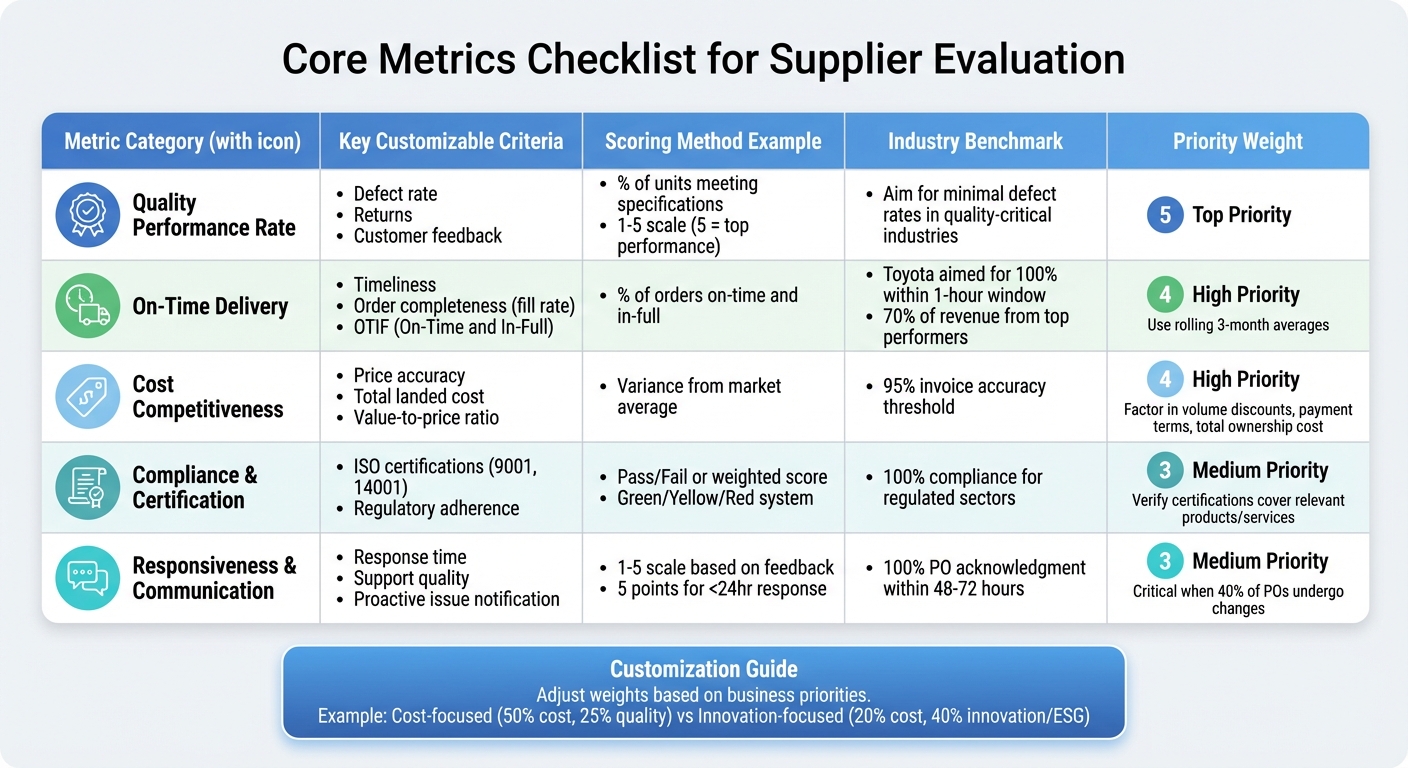
5 Essential Supplier Evaluation Metrics and Scoring Methods
When evaluating suppliers, certain key metrics provide a solid foundation for making informed decisions. These indicators can be tailored to match your operational goals, whether you prioritize lean practices or need to meet stringent regulations. Let’s break down the essential metrics that drive effective supplier assessments.
Quality Performance Rate
This metric measures the percentage of defect-free units delivered, calculated as defect-free units divided by total units.
How to set benchmarks: Analyze customer complaints and return rates over a meaningful timeframe. In industries where quality is critical, aim for minimal defect rates. Assign weights that reflect the operational impact of quality issues. Monitoring how quickly suppliers resolve quality-related problems is equally important. A standardized scoring system - like a 1–5 scale where 5 represents top performance - can help ensure fair comparisons across suppliers.
On-Time Delivery Percentage
On-time delivery is calculated by dividing the number of on-time deliveries by the total deliveries. However, the definition of "on-time" can vary. Some businesses consider a delivery on-time if it arrives on the promised date, while others use OTIF (On-Time In-Full), which requires the entire order to arrive as scheduled.
For example, Toyota Industrial Equipment Manufacturing aimed for a 100% on-time delivery rate within a one-hour window back in 2011. Bruce Nolting, their Senior Manager of Purchasing and Production Control, noted: "Delivery is the most challenging aspect of (supplier) development".
Your approach should depend on the criticality of the items. High-priority items may require strict adherence to delivery schedules, while less critical items might allow for more flexibility. Use rolling three-month averages instead of single-month snapshots to get a clearer picture of performance trends. Categorizing suppliers into performance tiers can also help identify strengths and weaknesses. Suppliers with strong on-time delivery records often contribute significantly to a company’s revenue - up to 70% in some cases.
Cost Competitiveness Index
This metric evaluates the overall value of supplier pricing, factoring in unit costs, volume discounts, payment terms, and total cost of ownership. For instance, a higher unit price might be offset by perks like favorable payment terms or free shipping.
To assess competitiveness, compare pricing against market averages and track invoice accuracy. For example, maintaining a 95% accuracy threshold can help flag discrepancies and trigger alerts automatically. Weight this metric based on your business model. If cost plays a significant role in your competitive strategy, it might deserve a higher weight in your overall supplier score.
Compliance and Certification Score
Compliance is about ensuring suppliers meet safety regulations, tax requirements, and other industry-specific standards. Certifications like ISO 9001 for Quality Management or ISO 14001 for Environmental Management should be verified to confirm they cover the relevant products or services.
A simple "Green/Yellow/Red" system can make compliance tracking easier. For example, no service-level breaches earn a green rating, while repeated issues lead to a red rating, potentially triggering contract enforcement measures. In 2025, UPL centralized supplier risk tracking with dashboards, achieving 100% PR-to-PO adoption in India operations. Sylesh Gopan, Global ERP Head at UPL, said: "The biggest benefit is having a single source of truth in one centralized platform".
Adjust the weight of compliance metrics based on industry demands. Highly regulated sectors may require more frequent reviews, while low-risk suppliers might only need annual assessments.
Responsiveness and Communication Effectiveness
Communication is critical, especially when roughly 40% of purchase orders undergo changes. Evaluate how quickly suppliers acknowledge purchase orders, with a standard goal of a 100% acknowledgment rate within 48–72 hours.
Suppliers who notify you in advance about potential issues, like shortages, provide valuable time to adjust. In contrast, last-minute updates can severely disrupt operations. A scoring system can help quantify performance - for instance, awarding five points for responses within 24 hours and clear action plans, and fewer points for delays or vague communication.
Summary of Key Metrics
| Metric Category | Key Customizable Criteria | Scoring Method Example |
|---|---|---|
| Quality | Defect rate, returns, customer feedback | % of units meeting specifications |
| Delivery | Timeliness, order completeness (fill rate) | % of orders on-time and in-full |
| Cost | Price accuracy, total landed cost, value-to-price ratio | Variance from market average |
| Service | Response time, support quality | 1–5 scale based on feedback |
| Compliance | ISO certifications, regulatory adherence | Pass/Fail or weighted score |
Each of these metrics can be adapted to meet your specific business needs, ensuring evaluations align with your operational priorities.
Customizing Metrics with Leverage AI
Relying on Excel-based scorecards can be a headache - they're outdated almost as soon as they're created and require constant upkeep. Leverage AI solves this problem by automating the evaluation process, pulling data directly from purchase orders, invoices, and audits into live dashboards that update in real time.
The platform goes a step further by organizing data buried in scattered emails and PDFs - information that most ERP systems overlook. This "first mile" of supply chain data becomes actionable through automated supplier scorecards, which combine hard numbers with qualitative insights like incident reports and chat logs. Andrew Stroup, CEO and Co-founder of Leverage, sums it up:
"The scorecard blends these data points into a score from 1–100, providing a clear measure of performance and eliminating subjective bias from evaluations".
Leverage AI also allows businesses to assign different weights to KPIs based on their strategic priorities. For example, delivery performance might make up 40% of a supplier’s score when assessing direct materials but only 10% when evaluating professional services. Its Analytics API seamlessly integrates detailed, time-series metrics into BI tools and data warehouses. Real-time dashboards provide a full picture of supplier responsiveness - not just delivery dates, but also how quickly suppliers acknowledge purchase orders, respond to open order reports, and share shipment updates.
These "soft" metrics are critical for spotting potential disruptions early. The system can automatically trigger reviews when certain thresholds are crossed. For instance, if a supplier's delivery rate falls below 90%, the platform alerts the relevant category owner.
Leverage AI also automates the calculation of KPIs like supplier response rates and On-Time In-Full (OTIF) scores. Considering that inaccurate supplier data costs companies roughly $15 million annually, this automation not only cuts operational costs but also minimizes the risks tied to outdated information. This streamlined framework makes it easy to integrate your own custom KPIs into a live, continuously updated monitoring system.
sbb-itb-b077dd9
Implementation Checklist for Custom Metrics
Define Business-Specific Weights and Benchmarks
Tie your metrics directly to outcomes that matter most to your business. For instance, if maintaining consistent quality is your edge in the market, it should take precedence over cost. On the other hand, if cutting costs is your priority, adjust the weights accordingly. Here's an example of how these priorities can shift based on your strategic focus:
| Category | Cost-Focused Year | Innovation-Focused Year | Standard Baseline |
|---|---|---|---|
| Cost Performance | 50% | 20% | 30% |
| Quality | 25% | 25% | 30% |
| On-Time Delivery | 15% | 15% | 20% |
| Innovation/ESG | 10% | 40% | 20% |
Start by interviewing key stakeholders to identify performance gaps and define what success looks like for each department. Then, categorize your suppliers into groups like Strategic Partners, Standard Suppliers, or Low-Risk Vendors. This ensures your evaluation criteria align with the supplier's importance to your operations.
Keep your focus sharp by limiting your evaluation to 5–10 key performance indicators (KPIs). Use historical data from the past year to establish realistic benchmarks. Once defined, integrate these metrics into your systems for real-time tracking.
Integrate Metrics with Real-Time Monitoring Tools
Ditch manual scorecards and opt for tools that leverage AI to pull real-time data from your ERP system. This approach reduces errors from manual data entry by as much as 90%.
Set up threshold bands to catch early warning signs - like a supplier moving from Green to Yellow - before major issues arise. The system's Analytics API can feed these metrics into your existing business intelligence tools, eliminating the need for your team to learn new software.
Schedule Regular Reviews and Refinements
Even with customized metrics and real-time data, regular reviews are essential to stay aligned with your goals.
Structure your review schedule based on how critical a supplier is to your business. For example:
- Critical Suppliers: Monthly or quarterly check-ins with continuous oversight.
- Strategic Partners: Quarterly in-depth reviews and an annual comprehensive assessment.
- Standard or Low-Risk Suppliers: Annual reviews, unless flagged by automated alerts.
Use rolling three-month averages to filter out anomalies and highlight meaningful trends. Involve suppliers in the review process so they understand their scores and what steps can boost their performance.
"The scorecard should act as an incentive, rather than a penalty, for suppliers".
Monitoring and Updating Custom Metrics
Use Real-Time Insights for Continuous Evaluation
Keeping supplier evaluations up-to-date is essential, and real-time data integration makes it possible. Metrics quickly lose their relevance when they’re outdated, and without continuous monitoring, potential issues can slip through the cracks. Considering that supply chain disruptions cost companies over $100,000 on average, maintaining constant visibility isn't just practical - it’s a financial safeguard.
AI-powered tools like Leverage AI streamline this process by pulling data directly from ERP systems, cutting down on manual errors. Automated alerts flag problems like compliance breaches, shipment delays, or quality concerns, allowing teams to act immediately.
Predictive analytics takes this a step further by identifying early warning signs in supplier performance. For instance, Stonegate Tooling uses real-time tracking tools to monitor underperforming suppliers, helping them avoid extended lead times and the backorders that follow.
These real-time insights provide the foundation for adapting and improving your metrics as your business priorities shift.
Refine Metrics Based on Business Changes
Supplier metrics should evolve alongside your business strategy. Whether your company is targeting net-zero emissions, adopting new technologies, or expanding into new markets, your KPIs need to reflect these changes.
Adapting metrics is also crucial when external factors, like updated ESG regulations, come into play. With 87% of procurement professionals now citing supplier risk management as a top priority, focusing on risk and resilience has become increasingly important.
Operational changes on the supplier side - such as shifts in management or the introduction of new product lines - should also trigger a review of your metrics. The goal is to concentrate on metrics that lead to actionable improvements and align with your evolving objectives.
Conclusion
Tailored metrics are a game-changer when it comes to evaluating suppliers effectively. Generic scorecards simply don’t cut it - every business has unique goals, whether it’s achieving net-zero emissions, minimizing defect rates, or streamlining inventory. By customizing metrics to align with your priorities, you shift from relying on guesswork to making clear, data-driven decisions that directly affect your bottom line. Companies that work closely with their suppliers grow twice as fast as those that don’t. On the flip side, supply chain disruptions can slash profits by 62%, making it critical to get your evaluation framework right.
Traditional data collection methods, spread across multiple systems, often lead to delays and inefficiencies. That’s where AI-powered tools like Leverage AI step in. By integrating seamlessly with your ERP, Leverage AI automates data collection, providing real-time dashboards that eliminate hours of spreadsheet work and reduce manual errors by up to 90%. This gives your team instant insights into critical areas like quality, delivery, and compliance.
Customizable metrics aren’t static - they grow with your business. Whether you’re embracing new technologies, adapting to ESG regulations, or entering new markets, your supplier KPIs need to evolve. Leverage AI simplifies this process with automated alerts and tools for updating benchmarks and weightings in real time. Thanks to its ERP integration, these changes happen instantly, keeping your supply chain aligned with your shifting priorities and goals.
Effective supplier evaluation isn’t just about tracking numbers; it’s about driving growth and resilience.
"Evaluating supplier performance isn't just paperwork - it's about building a supply chain that helps your business thrive." - Esgrid
FAQs
How do custom metrics enhance supplier evaluation compared to standard ones?
Custom metrics are a powerful way to ensure your supplier evaluations align closely with your business goals - whether you're prioritizing quality standards, cost efficiency, risk management, or collaborative efforts. Unlike standard metrics that offer broad, one-size-fits-all insights, custom metrics provide data that’s specifically tailored to your unique operational needs.
By zeroing in on the factors that matter most to your business, these metrics make it easier to pinpoint strengths and weaknesses in supplier performance. This targeted approach not only helps you make smarter, data-driven decisions but also strengthens supplier relationships, paving the way for meaningful improvements and long-term success.
How does AI simplify and improve supplier evaluations?
AI simplifies the process of evaluating suppliers by analyzing vast amounts of performance data and applying machine learning to deliver insights in real time. It can anticipate potential risks, assign performance scores, and even automate follow-up actions, allowing businesses to manage suppliers more effectively and stay ahead of issues.
By using Leverage AI, companies can tap into features like automated tracking of purchase orders, real-time visibility into their supply chain, and continuous monitoring of supplier performance. These tools integrate smoothly with existing ERP systems, improving efficiency and reducing delays. The result? Supplier evaluations become more precise and practical.
What’s the best way to choose custom metrics for evaluating supplier performance?
To choose the right custom metrics, start by tying them directly to your business objectives. Pinpoint key goals like cutting costs, boosting on-time deliveries, or improving product quality. Bring together stakeholders from procurement, operations, and finance to identify which supplier performance factors are most critical for your organization.
Put your focus on impactful areas such as delivery reliability, quality compliance, cost efficiency, risk management, and collaboration. Let data guide your decisions - use insights from historical spend, defect rates, and lead-time variability to zero in on metrics that align with your goals and can be consistently tracked.
AI-powered tools like Leverage AI make this process easier by analyzing ERP data, spotting performance trends, and suggesting metrics tailored to your strategic goals. This approach helps ensure your supplier scorecard remains relevant and adapts as your business evolves.